Databases
What is a database
An electronic database is a collection of data or information that is structured in a way to ease the storing, retrieval, modification and removal of data and is organised for quick search and retrieval by a computer(BRITANNICA, 2020).As Kappagantula(2019) explains, a "DBMS or Database Management System is a software application used to access, create, and manage databases". In other words, a DBMS allows the retrieval, updating and creation of data from a database with ease. Furthermore, with the aid of commands, a database can be manipulated and made to act as an interface between an end user and a database (Kappagantula, 2019).
Some of the advantages of using a DBMS according to PRASHANT(n.d) are:
- -Minimising data inconsistency
- -Controlling duplicate data
- -Easy data manipulation
- -Easy data sharing
- -Better data security
- -Multiple users are able to access the data at once
Two examples of database software are:
- Microsoft Access DBMS
- MySQL
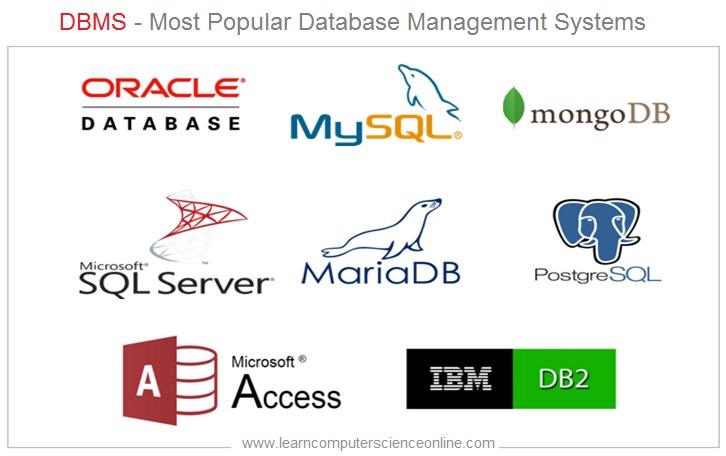
(LEARNCOMPUTERSCIENCEONLINE, n.d.)
Reference List:
BRITTANICA, (2020). database | Definition, Types, & Facts. [online] Encyclopedia Britannica. Available at: <https://www.britannica.com/technology/database> [Accessed 17 February 2021].
Kappagantula, S. (2019). What is DBMS? | Database Management Systems | Edureka. [online] Edureka. Available at: <https://www.edureka.co/blog/what-is-dbms> [Accessed 16 March 2021].
LEARNCOMPUTERSCIENCEONLINE, (n.d). Most Popular Database Management Systems. [image] Available at: <https://www.learncomputerscienceonline.com/wp-content/uploads/2019/08/Most-Popular-DBMS-Database-Management-Systems.jpg> [Accessed 19 February 2021].
Not very detailed, more information is required about DBMS, database languages and advanatges.
ReplyDelete